
3 Steps towards Sustainability and Social Justice in Cannabis
The last two years’ combination of climate crisis, COVID-19 and BLM protests around the world makes one thing very clear: environmental sustainability and social justice are linked. “The overall problem is that we are not sustainable in the ways we are living and producing on the planet today,” said Lise Kingo, the executive director of the UN Global Compact..
The legacy cannabis growers of the Emerald triangle went back to the land decades ago to live an alternative way of life that cared for nature and for each other. From the start, it was about humans and community as much as it was about ecology. Their experience reveals three steps to take, or aspire towards, to commit to sustainable development.
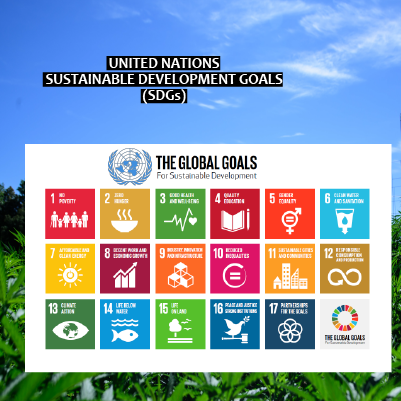
The frameworks for this are the United Nations Sustainable Development Goals (SDGs) and the Sun+Earth 3 pillars, because, while there are others with outstanding environmental standards, these two put social justice at the center of their sustainability.
In 2015, the United nations adopted the 17 global Sustainable Development Goals (SDGs) with the objective to transform the world. “Sustainability is a good concept to approach all of life,” explains Kenzi Riboulet-Zemouli, a researcher who’s been providing recommendations to the WHO and United Nations for the last 5 years. “It’s essential to protect small farmers and the knowledge that’s been passed through generations.”
The Sun+Earth certification was developed “as a resistance against industrial agriculture taking the cannabis space,” explains co-founder Andrew Black. “The essence is to keep legacy, artisanal, organic farmers farming.”
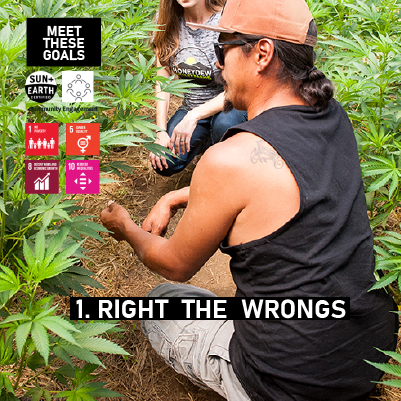
1. Right the wrongs
People of color and women have been disproportionally targeted by penalties and incarceration in the war on drugs, yet women are represented at higher percentage in cannabis than in other industries. Buy from black-owned and women-owned businesses--see the database by Cannaclusive [https://www.cannaclusive.com/inclusivebase]. And get engaged with The Last Prisoner Project [https://www.lastprisonerproject.org/] that aims to bring restorative justice to the cannabis industry. (SDG Goal #1 No Poverty, Goal #5 Gender Equality, Goal #8 Decent Work, Goal #10 Reduced Inequalities. Sun+Earth Community Engagement.)
2. Give to compassionate care
The health benefits of cannabis are increasingly recognized at the scientific level. But already back in 1996, Joe Airone started Sweetleaf Collective to provide plant-based medicine to terminally ill cancer and HIV/AIDS patients in the Bay Area. Donate to non-profits like Sweetleaf Collective and others. In Humboldt, growers have been cultivating medicine for decades, and helping those in pain. And the HPRC dispensary has a nurse on staff that can help educate about safe medical options. (SDG Goal #3 Good Health & WellBeing. Sun+Earth Human Empowerment).
3. Choose sun-grown
There is a place for indoor cultivation, but in the long-term, sun-grown cannabis is the right environmental choice. And small-batch sungrown cannabis is an intense expression of the terroir, so it will increasingly fetch a premium. Moving away from resource-extracting artificial light production is also the right social justice choice. Globally, people of color are on the front line of the climate crisis, so our decisions in production and consumption have an impact. (SDG Goal #7 Affordable Clean Energy, Goal #13 Climate Action, Goal #14 Life below Water, Goal #15 Life on Land. Sun+Earth Earth Care & Cultivation).
Rising to the challenge of sustainable development may seem overwhelming, but there are steps we can take immediately, individually and collectively. Buying from black-owned and woman-owned businesses helps rebalance inequalities; donating towards compassionate care reconnects cannabis as medicine; and preferring sun-grown products protects both local small farms and global minorities. Whether you’re a farmer or a consumer, it’s possible to start with these three conscious choices, and support each other’s journey into full sustainability.
##
Nicole Riggs is the founder of Manifesto Synergies, an agency providing brand strategies to woman-owned businesses and nonprofits in the cannabis industry. She sits on the board of the Humboldt Community Business Development Center (HCBDC) and is an Affiliate Researcher with the Center for the Study of Cannabis and Social Policy (CASP).